Tirzepatide Dosing Chart: Complete Week-by-Week Schedule
Medically Reviewed
Dr. Sean Arora, MD
Board-certified physician
Last reviewed: October 11, 2025
Tirzepatide's dosing schedule spans about five months and six dose levels. This comprehensive chart walks you through each phase, helping you understand when increases happen, what to expect at each dose, and how to determine your ideal maintenance level.Looking for the semaglutide dosage chart instead?
Quick answer
Tirzepatide titrates from 2.5mg weekly through 5, 7.5, 10, 12.5, and a maximum 15mg, holding each step at least 4 weeks before stepping up, per FDA prescribing information. Most reach a maintenance dose around week 20. Never adjust a dose without provider guidance; individual outcomes vary.
The Tirzepatide Dosing Chart in Plain Words
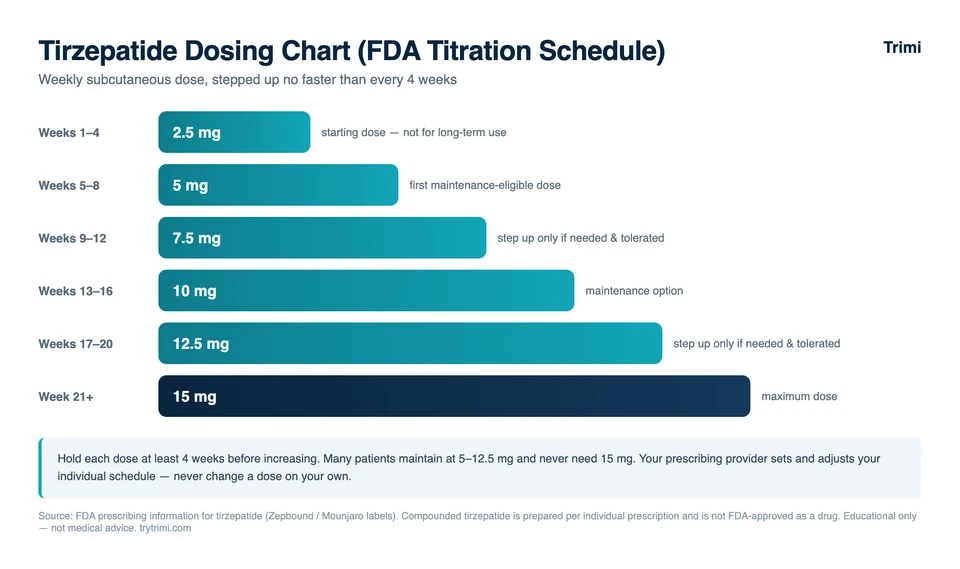
The tirzepatide dosing chart is a six-step weekly injection schedule. You start at 2.5mg once weekly, and the dose steps up about every 4 weeks through 5mg, 7.5mg, 10mg, and 12.5mg to a maximum of 15mg weekly. Each step is held for at least 4 weeks before the next increase, and most people reach their maintenance dose around week 20.
| Weeks | Weekly dose |
|---|---|
| Weeks 1-4 | 2.5 mg (starting dose) |
| Weeks 5-8 | 5 mg |
| Weeks 9-12 | 7.5 mg |
| Weeks 13-16 | 10 mg |
| Weeks 17-20 | 12.5 mg |
| Week 21 onward | 15 mg (maximum) |
Three rules cover most questions about the chart: never step up sooner than 4 weeks at a dose, you can stop climbing at any dose that controls appetite well (many people maintain at 10mg or 12.5mg and never take 15mg), and every schedule change goes through your prescriber. The sections below expand each phase of the chart, what to expect month by month, and how to handle missed doses, restarts, and compounded vial measurements.
Understanding Tirzepatide's Unique Titration
Tirzepatide follows a 20-week titration schedule to reach maximum dose. As a dual GIP/GLP-1 receptor agonist, tirzepatide works through two distinct mechanisms simultaneously. Your body needs adequate time to adjust to both pathways, which makes the gradual dose escalation critical.
Think of it this way: tirzepatide activates twice as many receptors as single-mechanism GLP-1 medications. That dual action delivers more powerful weight loss results-clinical trials showed average weight loss of 20.9% at the maximum dose-but requires a careful approach to minimize side effects during the ramp-up period.
The SURMOUNT-1 trial published in NEJM, which established tirzepatide's efficacy for weight loss, tested various titration schedules before determining this specific protocol provided the best balance: rapid enough to see meaningful results within months, but gradual enough that most patients tolerate it well. Patients who tried to accelerate through doses faced significantly higher discontinuation rates due to severe nausea and gastrointestinal distress.
Complete Tirzepatide Dosing Timeline
Standard 20-Week Titration Schedule
Weeks 1-4
Foundation Phase
Starting dose for body acclimation. Minimal therapeutic effect expected. Focus: establishing injection routine and monitoring tolerance. Average weight loss: 1-3 lbs total.
Weeks 5-8
Early Response Phase
First increase. Body continues adapting to medication. Average weight loss: 3-6 lbs total. Appetite changes becoming noticeable.
Weeks 9-12
Early Therapeutic Phase
First therapeutic increase. Noticeable appetite suppression begins for most patients. Weekly weight loss: 1.5-2.5 lbs typical. Side effects most common 2-3 days post-injection.
Weeks 13-16
Accelerated Response Phase
Strong appetite control established. Weight loss often accelerates to 2-3 lbs weekly. Many patients report significant changes in food preferences and portion sizes.
Weeks 17-20
Primary Therapeutic Dose
Robust therapeutic effect. Approximately 40% of patients find their optimal maintenance dose here. Consistent 2-3 lb weekly weight loss common.
Weeks 21+
Maximum Maintenance Dose
Maximum approved dose. Clinical trials demonstrated average 20.9% total body weight reduction over 72 weeks. Represents peak therapeutic effect for chronic weight management.
Critical Schedule Reminders
- • Each dose level requires minimum 4 weeks before advancing (no shortcuts)
- • Reaching maximum 15mg dose is not mandatory-find your optimal level
- • You can pause progression at any dose that delivers good results with minimal side effects
- • Provider approval required for any schedule modifications
- • Side effects typically peak 48-72 hours after dose increases
Clinician-guided titration
Get a tirzepatide plan matched to your titration step
Trimi pairs you with a licensed provider who sets your start dose and step-ups based on your response, not a fixed chart. Compounded tirzepatide is $125/mo and semaglutide is $99/mo, all-inclusive and backed by a 6-month money-back policy; individual results vary.
Start your online visitMonth-by-Month: What Really Happens
Month 1: Getting Started (2.5mg)
Your first month on tirzepatide centers on adaptation rather than dramatic weight loss. At the 2.5mg starting dose, tirzepatide's dual-agonist mechanism begins activating both GIP and GLP-1 receptors, but at a level low enough that most patients experience minimal side effects.
What to expect realistically: Some patients notice subtle appetite changes-perhaps snacking less between meals or feeling satisfied with slightly smaller portions. Others experience virtually no change this first month, which is completely normal and expected. The 2.5mg dose isn't designed to produce significant weight loss; it's preparing your body for the therapeutic doses ahead.
Common experiences: Mild nausea affecting about 20% of patients (usually resolves within 48 hours). Slight decrease in appetite beginning week 2-3. Minimal to no side effects for roughly 70% of patients. Weight loss averaging 1-3 pounds total for the month-modest but expected at the starting dose.
Focus this month: Establish your weekly injection routine. Choose a consistent day and time. Learn proper injection technique and site rotation. Begin tracking weight, side effects, and appetite changes to establish your personal baseline.
Month 2: First Step-Up (5mg)
The increase to 5mg, typically at week 5, is your first dose step-up. This is when tirzepatide's dual mechanism starts producing more noticeable effects. Your GIP receptors enhance insulin response and improve how your body processes nutrients, while GLP-1 receptor activation slows gastric emptying and directly reduces appetite.
The reality check: Your first 5mg injection often brings temporary side effects as your body adjusts. Expect possible nausea for 2-3 days-uncomfortable but manageable for most patients. Within a week these effects typically diminish significantly as your receptors adapt to the higher medication level.
Weight loss begins: Most patients start losing weight more steadily at this dose-often 3-6 pounds across the month, often enough that clothes start fitting differently and others begin noticing changes. Your appetite suppression becomes more obvious: meals that previously satisfied you now seem too large, and the constant background hunger that characterized your pre-treatment life fades considerably.
Metabolic shifts: Beyond appetite changes, many patients report altered food preferences. Rich, heavy foods lose their appeal. High-fat meals that once sounded delicious now cause mild queasiness. These changes aren't forced-they happen naturally as tirzepatide modulates your brain's reward pathways related to food.
Month 3: Therapeutic Range (7.5mg)
By month three you reach 7.5mg (weeks 9-12), tirzepatide's first clearly therapeutic level. Your body has had 8 weeks to adapt, so this increase typically triggers less dramatic side effects than the earlier step-ups because your receptors have developed tolerance to the medication's presence.
Weight loss velocity: Many patients now lose 1.5-2.5 pounds weekly-roughly 6-10 pounds for the month. You're around 12 weeks into treatment, and physical changes become noticeable: clothes fit differently and others may start commenting.
Appetite control: At 7.5mg, most patients describe feeling far more in control around food. The medication doesn't eliminate hunger entirely-you still experience physical hunger signals when your body needs nutrition-but the obsessive food thoughts, constant cravings, and emotional eating impulses diminish dramatically.
Energy and wellbeing: Assuming adequate protein and hydration intake, energy levels often improve significantly. The combination of meaningful weight loss, stable blood sugar, and reduced inflammation from tirzepatide's metabolic effects translates to better stamina and mental clarity.
Month 4: Acceleration (10mg)
The 10mg dose (weeks 13-16) is where many patients experience their fastest, most consistent weight loss. Your body is now well-adapted to tirzepatide's dual mechanism, and appetite control is robust.
Peak weight loss velocity: 2-3 pounds weekly is common at this stage-around 8-12 pounds for the month. By week 16 of treatment, many patients have lost 18-25 pounds total. Physical changes become undeniable: face slimming, waistline shrinking, overall body composition visibly shifting.
The decision point: Approximately 40% of patients find their optimal maintenance dose at 10mg and never need to advance further. After 4 weeks at 10mg, you and your provider will evaluate whether stepping up to 12.5mg makes sense. Key considerations: Are you still losing 1-2+ pounds weekly? How tolerable are any side effects? Have you reached or approached your goal weight? Is the current dose effectively controlling appetite?
If you're losing weight steadily with minimal side effects but haven't reached your goal, advancing makes sense. If side effects are bothersome or you're approaching your target weight, staying at 10mg often proves the better strategy. Remember: clinical trial participants who remained at lower doses still achieved remarkable outcomes-there's no failure in finding your ideal dose below the maximum.
Month 5+: Maintenance & Maximum Dose (12.5-15mg)
Patients who need additional appetite control step up to 12.5mg (weeks 17-20) and, if appropriate, the maximum 15mg dose from around week 21. In the SURMOUNT-1 trial, the 15mg dose produced average weight loss of about 20.9% of body weight over 72 weeks-among the most significant results documented for any obesity medication.
Who benefits most: Patients with more weight to lose (higher BMI) who tolerated lower doses well and continue needing robust appetite suppression, and those who plateaued at 10mg but haven't reached their health goals. Reaching the maximum dose is never mandatory-many patients do best at 10mg or 12.5mg.
Long-term expectations: At a maintenance dose, most patients transition from rapid weight loss to steady, sustainable reduction. Expect 1-2 pounds weekly if you have significant weight remaining to lose, or weight stabilization if you've approached your goal. The medication continues providing powerful appetite control.
Staying power: Research indicates that patients who reach and maintain maximum dose have excellent long-term adherence. The initial titration difficulties have long passed, side effects typically remain minimal at this stage, and the dramatic results serve as powerful motivation to continue treatment.
Customizing Your Dosing Schedule
The standard 4-weeks-per-dose schedule works well for most patients, but individualization matters. Here's when and how to modify your progression:
When Slower Titration Makes Sense
Persistent Side Effects
If nausea, vomiting, or GI issues continue beyond the first week after a dose increase, extending that phase to 6-8 weeks allows more adaptation time. No point advancing if you're struggling to maintain adequate nutrition.
Implementation: Simply stay at your current dose for the additional weeks. Your next injection continues at the same level until side effects resolve. Then wait 4 more weeks at that dose before considering advancement.
Older Adults (65+)
Older patients often benefit from extending each dose phase to 6 weeks. Age-related changes in metabolism, kidney function, and medication sensitivity mean a more conservative approach often produces better outcomes with fewer complications.
History of GI Sensitivity
Patients with pre-existing conditions like IBS, gastritis, or GERD sometimes require longer acclimation periods. If you've always had a sensitive stomach, discuss a modified schedule with your provider from the start.
When Faster Progression Might Work
Faster titration is rare but occasionally appropriate:
- Exceptional tolerance: If you experience absolutely zero side effects through multiple dose increases, your provider might consider 3-week phases instead of 4-week. This remains uncommon-most patients do better with standard timing even when tolerating the medication well.
- Previous GLP-1 experience: Patients transitioning from semaglutide sometimes accelerate through early tirzepatide doses since their bodies are already adapted to GLP-1 receptor activation. However, the GIP component is new, so caution remains warranted.
- Medical urgency: In cases where rapid weight loss is medically necessary (pre-surgical requirements, severe diabetes complications), providers may adjust how long you hold each standard dose level, but not shorter than the 4-week minimum; moving through the 2.5mg to 15mg schedule faster than the standard 4-week steps is not recommended, and any schedule change goes through your prescriber.
The Optimal Dose Philosophy
Your optimal dose is the lowest dose that delivers excellent results with minimal side effects-not necessarily the highest dose you can tolerate. Clinical success is measured by sustainable weight loss and improved health markers, not by reaching 15mg.
Many patients achieve complete remission of diabetes, normalize blood pressure, and reach healthy body weights at 10mg or 12.5mg. If that describes you, advancing further offers no additional benefit and potentially more side effects and cost. Find your sweet spot and stay there. If cost at higher doses is part of the decision, our cheapest tirzepatide providers ranking compares which programs raise prices as your dose climbs and which stay flat.
Tracking Your Dose Response
Systematic tracking helps you and your provider make data-driven decisions about dose progression. Here's what to monitor at each level:
Comprehensive Response Metrics
Weekly Tracking
Physical Metrics
- • Weight (same conditions each time)
- • Current dose and injection date
- • Side effect type and severity (0-10)
- • Energy levels (1-10 scale)
Appetite & Behavior
- • Hunger levels throughout week
- • Food cravings intensity
- • Portion size changes
- • Unusual food aversions
Monthly Assessment
- • Body measurements: Waist, hips, chest, thighs (more telling than scale sometimes)
- • Progress photos: Front, side, back in consistent lighting and clothing
- • Non-scale victories: Clothing fit, mobility improvements, medication changes
- • Health markers: Blood pressure, blood glucose, energy, sleep quality
- • Psychological factors: Mood, food relationship, confidence levels
Dose Increase Decision Matrix
Before each dose increase, evaluate these factors:
Completed minimum 4 weeks at current dose
Side effects resolved or minimal (≤3/10 severity)
Losing weight consistently (≥1 lb/week) OR
Weight loss has plateaued for 2+ weeks despite good adherence
Haven't reached goal weight yet
Provider approval obtained
If you can't check all these boxes, staying at your current dose longer is usually the better choice.
Finding and Maintaining Your Ideal Dose
Your maintenance dose is the level that sustains your weight loss, controls appetite effectively, produces minimal side effects, and fits your budget. This might be 10mg, 12.5mg, or 15mg-there's no "correct" answer that applies to everyone.
Signs You've Found Your Optimal Dose
- Consistent weight trends: Either continuing to lose 0.5-2 lbs weekly if still working toward goals, or maintaining stable weight if at target.
- Controlled appetite: Feeling genuine hunger at mealtimes but not obsessing about food between meals. Satisfied with appropriate portions.
- Minimal side effects: Any nausea, fatigue, or GI issues are rare, mild, and don't interfere with daily life.
- Good energy: Maintaining adequate protein and nutrition, feeling energetic rather than depleted.
- Sustainable adherence: The medication feels manageable long-term, not something you're white-knuckling through.
Long-Term Maintenance Strategies
Once you've identified your ideal dose, the focus shifts to sustainability:
- Regular monitoring: Continue weekly weigh-ins and monthly measurements even after reaching goal weight. Catching small regains early makes intervention much easier.
- Lifestyle integration: Tirzepatide works best as part of comprehensive lifestyle changes. Maintain protein intake (0.7-1g per pound target weight), stay active, prioritize sleep, manage stress.
- Provider check-ins: Schedule follow-ups every 3-6 months to assess continued need for medication, review side effects, and adjust if necessary.
- Dose flexibility: Some patients reduce their maintenance dose after achieving goals (like dropping from 12.5mg to 10mg). Others need to increase if weight begins creeping back. Both scenarios are normal and manageable.
The Reality of Long-Term Use
Current evidence suggests tirzepatide works as a long-term treatment for obesity, not a temporary fix. Discontinuation studies show most patients regain significant weight within months of stopping the medication. This isn't failure-it reflects obesity's chronic nature.
Think of tirzepatide like medications for high blood pressure or cholesterol. They work brilliantly while you take them, but the underlying condition remains. Many patients continue tirzepatide maintenance indefinitely, viewing it as managing a chronic health condition rather than a temporary weight loss intervention.
Special Dosing Scenarios
Restarting After Treatment Gap
Tirzepatide has a half-life of about 5 days, meaning it takes roughly 25 days for your body to fully clear the medication. How you restart depends on your break duration:
Missed 1-2 weeks (7-14 days)
Resume at your previous dose. You may experience mild side effects as medication levels rebuild, but full re-titration isn't necessary.
Missed 3-4 weeks (15-28 days)
Step back one dose level for 2 weeks, then resume your maintenance dose. Example: If you were at 10mg, restart at 7.5mg for 2 weeks, then return to 10mg.
Missed 5+ weeks (29+ days)
Full re-titration from 2.5mg recommended. However, you can progress through doses faster (2-3 weeks per level instead of 4) since your body has prior experience with the medication.
Switching from Semaglutide
Patients transitioning from semaglutide to tirzepatide don't always start at 5mg. Your starting dose depends on your semaglutide level:
Even though semaglutide and tirzepatide share GLP-1 activity, tirzepatide's additional GIP mechanism means starting conservatively makes sense. Most providers recommend starting one level lower than the equivalent dose, then advancing through the schedule.
Compounded Tirzepatide Dosing
Compounded tirzepatide typically comes in vials requiring manual measurement rather than fixed-dose pens. Common concentrations and their corresponding volumes:
| Target Dose | 10mg/ml Solution | 15mg/ml Solution |
|---|---|---|
| 2.5mg | 0.25 ml | 0.17 ml |
| 5mg | 0.50 ml | 0.33 ml |
| 7.5mg | 0.75 ml | 0.50 ml |
| 10mg | 1.00 ml | 0.67 ml |
| 12.5mg | 1.25 ml | 0.83 ml |
| 15mg | 1.50 ml | 1.00 ml |
Critical safety note: Always verify concentration and dosing calculations with your provider before administering compounded medication. Measurement errors with concentrated solutions can result in serious overdosing. Compounded tirzepatide is prepared per individual prescription and is not itself FDA-approved as a drug; see the FDA's compounding Q&A for how these preparations differ from brand products. This chart is general information, not medical advice; consult a licensed clinician and never adjust a dose without provider guidance.
When to Contact Your Provider Immediately
- • Persistent vomiting preventing food/fluid intake for 24+ hours
- • Severe abdominal pain, especially if accompanied by fever
- • Signs of dehydration: dark urine, dizziness, rapid heartbeat
- • Vision changes or severe headaches
- • Suspected allergic reaction: rash, itching, difficulty breathing
- • Suicidal thoughts or severe mood changes
- • Any symptom that significantly interferes with daily function
Your Dosing Journey: Final Perspective
This dosing chart represents months of gradual progression, but those months pass whether you're on tirzepatide or not. The difference is that following this schedule gives you a proven path to meaningful, sustainable weight loss backed by some of the strongest clinical evidence in obesity medicine.
Success with tirzepatide isn't about speed-it's about finding the approach that works for your body, tolerating the medication well enough to stick with it long-term, and achieving results that meaningfully improve your health and quality of life. Some patients reach those goals at 10mg. Others need 15mg. Both outcomes represent success.
Keep this dosing chart as your reference guide, communicate openly with your healthcare team, track your progress honestly, and trust that the gradual process serves an important purpose. In six months, when you're looking back at where you started, you'll understand why patience through this titration schedule mattered.
People Also Read
More on Tirzepatide
More Tirzepatide & GLP-1 Resources
If you're researching tirzepatide dosing, you may also find these guides useful:
- Zepbound Dosing Chart 2026, Brand-name tirzepatide schedule
- Cheapest Legal GLP-1 Online (2026, 50 States), Definitive cornerstone covering Trimi $125/mo annual tirzepatide vs Found, Mochi, Henry Meds, LillyDirect with 503A pharmacy compliance citations
- Wegovy Dosing Chart 2026, Semaglutide alternative
- Best Tirzepatide for Fast Approval 2026, Providers ranked by approval speed
- Best GLP-1 Providers with Coaching 2026
- Best Compounded Tirzepatide in South Carolina 2026
- Best Compounded Tirzepatide in Michigan 2026
- Wegovy HD 7.2mg Higher Dose 2026
- Tirzepatide provider comparison, Provider choice and pharmacy checks
- GLP-1 Without Membership Fees
Ready to Begin Your Tirzepatide Journey?
Get personalized dosing plans and expert medical guidance throughout your treatment
Start Your ConsultationWritten by Trimi Medical Team
Our team of healthcare professionals specializes in weight management and metabolic health, providing evidence-based information to help you make informed decisions about your health journey.
Medically reviewed by Dr. Sean Arora, MD
Sources & References
- Wilding JPH et al. Once-Weekly Semaglutide in Adults with Overweight or Obesity. NEJM 2021;384:989-1002.
- Jastreboff AM et al. Tirzepatide Once Weekly for the Treatment of Obesity. NEJM 2022;387:205-216.
- Lincoff AM et al. Semaglutide and Cardiovascular Outcomes in Obesity without Diabetes. NEJM 2023;389:2221-2232.
- FDA Prescribing Information for Wegovy (semaglutide) and Zepbound (tirzepatide).
Medical Disclaimer: This content is for informational purposes only and does not constitute medical advice. Always consult a qualified healthcare provider before starting any medication or treatment program.