
Monday tends to start strong for Americans trying to eat healthier. Meals are planned, motivation is high, and people are more likely to eat as intended. By Friday afternoon, those plans often start to loosen, and for many people, one off-plan meal can stretch into a whole weekend.
To find out when that slide begins and what helps people get back on track, Trimi surveyed 1,009 U.S. adults who are actively trying to lose or manage their weight. We asked about their weekly routines, cravings, and triggers, as well as what they do after an indulgence. Find out which days are hardest, what tends to knock routines off course, and the small habits that make a reset easier.
Key Takeaways
- Saturday is America's biggest cheat day, with 33% of Americans on a diet most likely to eat differently than they intended.
- Friday is the biggest trigger point, with 43% of Americans on a diet easing up on their health habits at some point on Friday.
- Half of Americans on a diet (50%) loosen their healthy habits before the weekend even starts, while just 1 in 10 (11%) wait until Saturday.
- 70% of Americans on a diet say that one slip snowballs into a lost day, weekend, or longer, at least sometimes.
- 66% of Americans on a diet promise themselves they'll start again on Monday after one slip.
- Eating the foods they intended to eat is the first habit to go as the weekend nears (17%), ahead of sleep (15%) and exercise (13%).
- People who reset at their very next meal are 3.1x less likely to fall into the "start again on Monday" loop than those who stay off plan for the rest of the weekend.
- Poor sleep (32%) is the No. 1 thing that breaks a healthy routine, edging out hunger and cravings (31%) and lack of motivation (30%).
- Current GLP-1 users are nearly 2x more likely to get back on track at their next meal than people who have never used one (31% vs. 17%).
When Healthy Habits Start to Slip During the Week
For most people trying to manage their weight, the week follows a familiar arc, with a focused start and a looser finish.
When people start easing up on health habits
- Thursday
- 7%
- Friday morning
- 6%
- Friday afternoon
- 11%
- Friday evening
- 26%
- Saturday
- 11%
- Sunday
- 2%
Selected timing responses are shown. The three Friday responses total 43%; Thursday and Friday together total 50%.
- Loosen their habits before the weekend starts
- 50%
- Wait until Saturday to ease up
- 11%
- Stay consistent all week
- 30%
- Have no set cheat day; it varies week to week
- 8%
- Most likely to eat as intended on Monday
- 38%
- Most motivated to reach health goals on Monday
- 36%
- Most likely to eat differently than intended on Saturday
- 33%
- Say one slip snowballs, at least sometimes
- 70%
- Promise to start again on Monday, at least sometimes
- 66%
Each finding comes from its own survey question. These percentages should not be combined across questions.
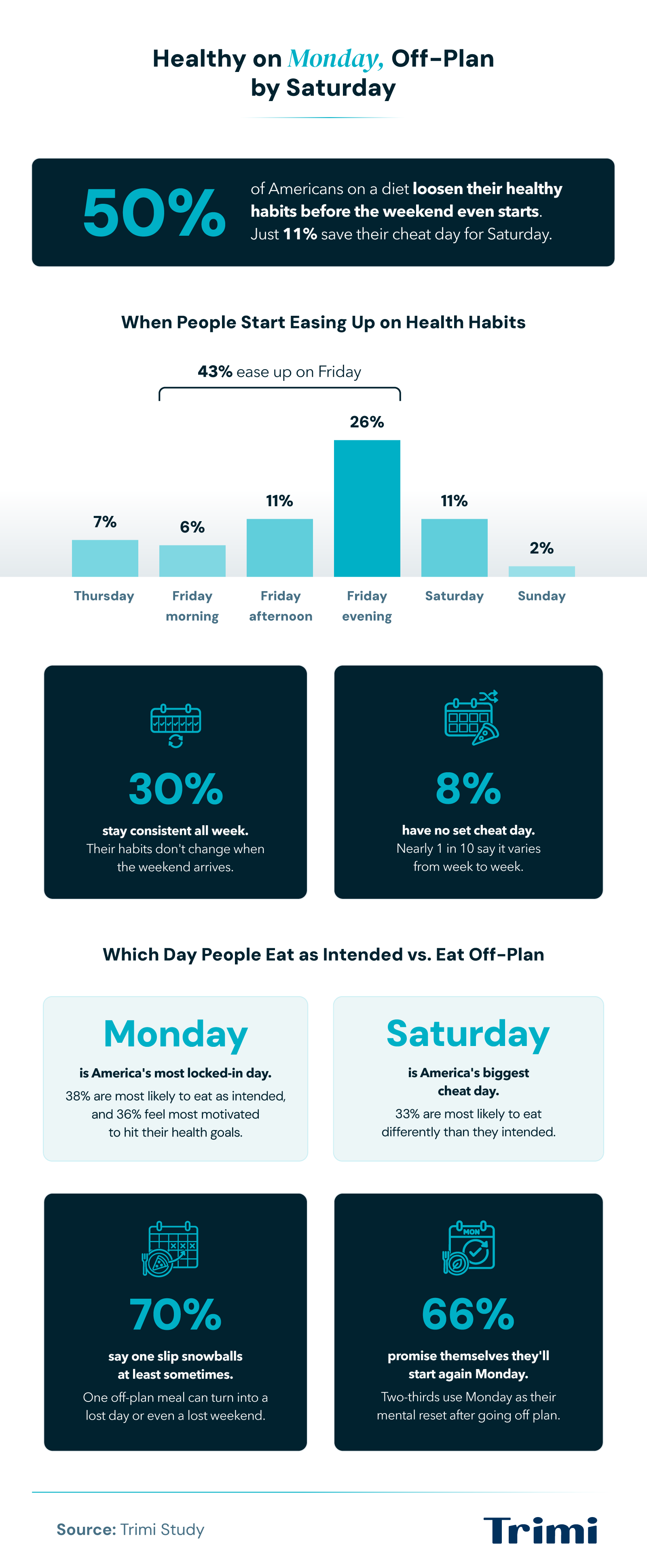
Half of the respondents (50%) started easing up on their healthy habits on Thursday or Friday, and only 11% waited until Saturday. Hybrid workers (58%) and Gen Z (56%) were the quickest to ease up before the weekend. Friday was the biggest trigger point for respondents, with 43% loosening their habits at some point that day, most often in the evening (26%).
Food choices were the first habit to go as the weekend neared (17%), ahead of sleep (15%) and exercise (13%). Dining out and takeout (40%) and parties or social gatherings (32%) were the hardest weekend situations to manage.
Consistency was possible, too. Overall, 30% said their habits didn't change on weekends, including 47% of baby boomers.
Strong Starts Give Way to Weekend Slips and Monday Resets
Monday was the most locked-in day of the week for Americans on a diet: 38% said they were most likely to eat as intended on Mondays, and 36% felt most motivated to hit their health goals that day. Women were more consistent on Mondays than men (42% vs. 34%), and Gen X led all generations (45%).
Saturday is the day when diet plans are most likely to fall apart. A third of respondents (33%) were most likely to eat differently than they intended on Saturday, and 29% called it the hardest day to stay on track. About 2 in 3 (66%) at least sometimes promised themselves they'd start again on Monday, which made Monday the go-to mental reset.
What Makes Healthy Routines Harder to Maintain
Most of what pulled people off plan had less to do with willpower and more to do with energy, timing, and the rhythm of the week.
Top reasons healthy routines break down
- Poor sleep or tiredness
- 32%
- Hunger or cravings
- 31%
- Lack of motivation
- 30%
- Convenient foods being easier to access
- 23%
- Decision fatigue or mental exhaustion
- 23%
- Work stress
- 20%
Multiple responses were allowed.
One slip snowballs: by generation
- Gen Z
- 79%
- Millennials
- 71%
- Gen X
- 65%
- Baby boomers
- 62%
Share within each generation saying one off-plan meal or missed workout derails the rest of the day, weekend, or longer, at least sometimes.
One slip snowballs: by gender
- Women
- 75%
- Men
- 62%
Share within each gender reporting this at least sometimes. The overall share was 70%.
- Cravings hit hardest at night
- 47%
- Feel they earned a cheat meal after staying on track, at least sometimes
- 76%
The nighttime finding combines late at night (29%) and after dinner (18%). Demographic findings are reported only for groups representing at least 5% of the sample.
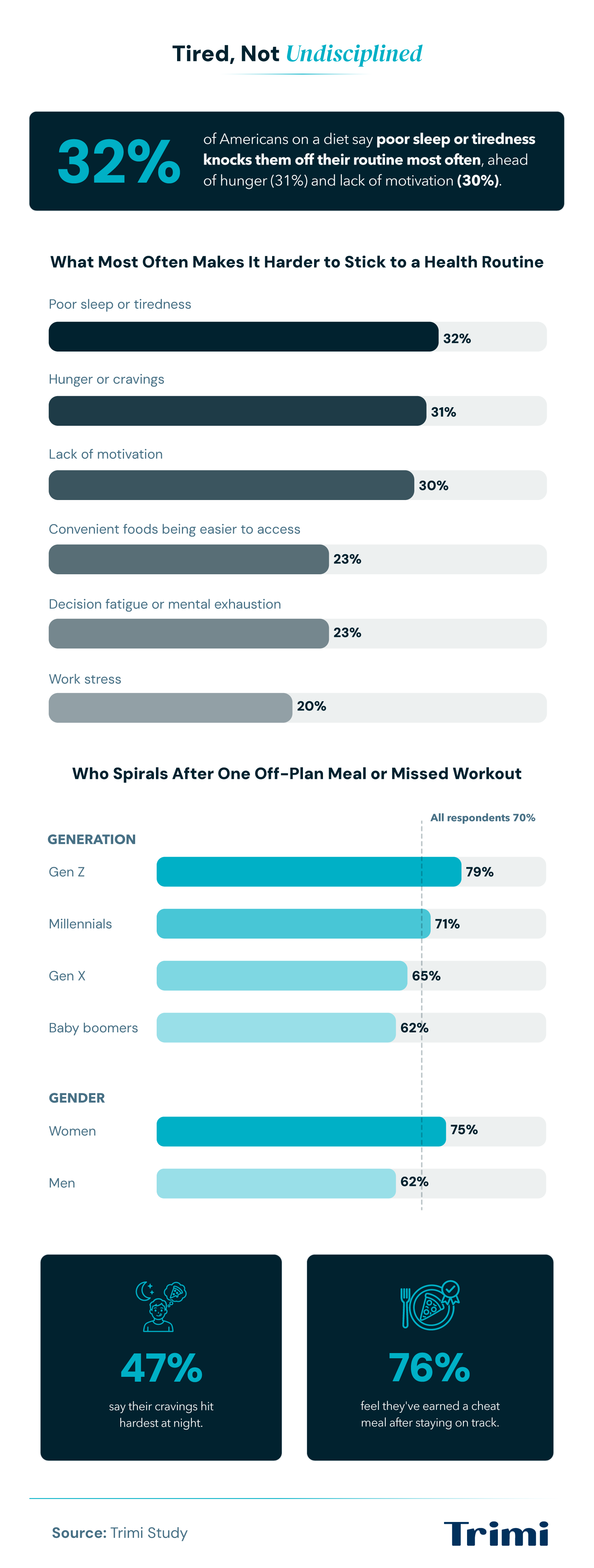
Poor sleep was the No. 1 thing that broke a healthy routine (32%), just ahead of hunger and cravings (31%) and lack of motivation (30%). Cravings hit hardest at night for 47% of respondents, combining late at night (29%) and after dinner (18%). Another 25% said late afternoon was the toughest stretch. Gen Z reported the most nighttime cravings (51%).
One slip, such as an off-plan meal or a missed workout, could throw off the rest of the day, weekend, or longer for 70% of Americans on a diet, and 30% said it happened often. Women were more likely than men to say one slip derailed them (75% vs. 62%). Gen Z was the most affected of any generation (79%), and 40% said it happened often or very often, roughly double the rate of baby boomers (19%). Fully remote workers were the least likely to spiral (65%, compared with 71% of hybrid and in-person workers).
Many people feel they deserve a reward after sticking to healthy habits, and they plan for their indulgences. About 3 in 4 (76%) at least sometimes felt they'd earned a cheat meal after staying on track. About the same share (73%) saved calories ahead of a cheat meal, most often by eating less earlier in the day (43%). They most often did so to enjoy a restaurant meal (45%), a favorite food or dessert (37%), or takeout or delivery (35%).
How People Get Back on Track After a Cheat Meal
A quick reset turned out to matter more than a perfect week.
What people do after a cheat meal
- Return to normal at the next meal
- 19%
- Wait until the next day
- 18%
- Wait until Monday
- 13%
- Eat less or exercise more to compensate
- 11%
- Stay off plan for the rest of the weekend or week
- 7%
- It varies by situation
- 26%
- This rarely or never happens
- 6%
Habits that help people get back on track
- Planning meals ahead of time
- 42%
- Allowing one planned indulgence, guilt-free
- 36%
- Walking or being active after meals
- 33%
- Keeping healthy snacks available
- 33%
- Keeping a normal sleep schedule
- 24%
Multiple responses were allowed.
Often or very often promise to start again on Monday
- People who reset at the next meal (n = 189)
- 19%
- People who stay off plan for the weekend or week (n = 69)
- 58%
The ratio of 58% to 19% is approximately 3.1. This is a comparison of self-reported groups, not an intervention or clinical outcome.
Usually return to their routine at the next meal: by GLP-1 use
- Current GLP-1 users
- 31%
- People who have never used a GLP-1
- 17%
This comes from the separate question about how long it usually takes to return to a routine, rather than the question about what happens after a cheat meal. This observational association does not show that medication caused a faster reset.
- Ratio comparing frequent Monday-restart responses: 58% versus 19%
- 3.1×
- Prefer slower progress with more flexibility
- 59%
- Prefer faster progress with more restrictions
- 15%
The survey asked about preferences and perceived habits. It did not measure weight-loss outcomes or treatment effectiveness.
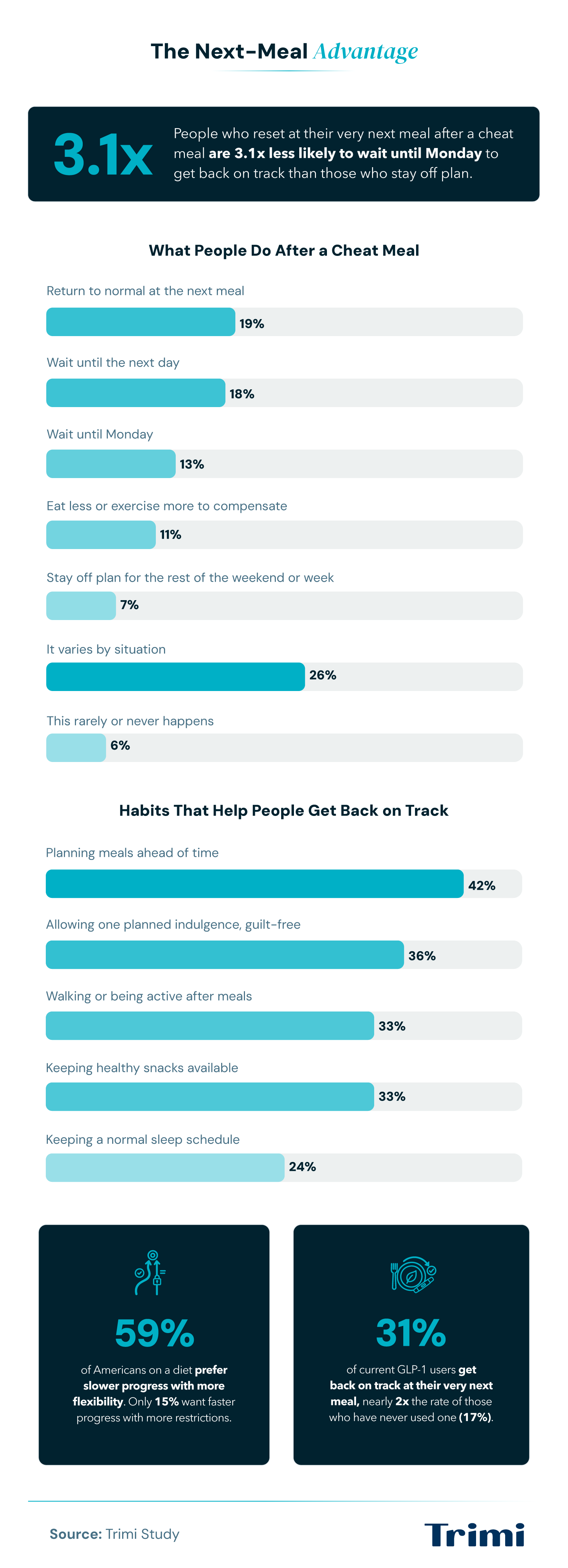
People who got back to their routine at the very next meal were 3.1 times less likely to fall into the "start again on Monday" loop than those who stayed off plan for the rest of the weekend. Among next-meal resetters, 19% said they often or very often told themselves they would start again on Monday, compared with 58% of those who stayed off plan.
Still, resetting at the next meal was not the most common response. After a cheat meal, 19% returned to normal at the next meal, 18% waited until the next day, and 13% waited until Monday. Another 26% said their response depended on the situation.
When respondents were asked more generally how long it usually took them to return to their routine, the most common answer was the next day (29%). Another 12% said they typically waited until Monday or another planned restart day. Current GLP-1 users were also nearly twice as likely as people who had never used one to get back on track at their next meal (31% vs. 17%).
Some habits appeared to make getting back on track easier. Planning meals ahead was the most common strategy (42%), followed by allowing one planned, guilt-free indulgence (36%). Walking after meals and keeping healthy snacks on hand were each cited by 33%.
Overall, respondents tended to favor flexibility over stricter routines. Given a choice, 31% would rather add more activity and 21% would eat smaller portions, while 11% would give up their favorite indulgent meals. About 3 in 5 (59%) said slower progress with more flexibility felt more sustainable, compared with 15% who preferred faster progress with more restrictions.
A Weekend Slip Doesn't Have to Wait for Monday
The weekly slide seemed to have more to do with tired evenings, Friday plans, and busy Saturdays than with a lack of discipline. Our data suggests the bigger difference came from how quickly people moved on after a slip in healthy habits.
If your routine tends to fade by Friday, a little planning for the moments you know are coming (a dinner out, a late-night craving) and a reset at your next meal rather than next Monday can help keep one indulgence from turning into a lost weekend.
Methodology
In September 2026, we surveyed 1,009 U.S. adults who are actively trying to lose or manage their weight, referred to in this study as Americans on a diet. The survey was fielded via CloudResearch Connect, and all participants were 18 or older.
Respondents were 62% women, 36% men, and 2% non-binary, another gender identity, or preferring not to say. By generation, 19% were Gen Z (18 to 29), 48% were millennials (30 to 45), 26% were Gen X (46 to 61), and 7% were baby boomers (62 and older). By work arrangement, 32% worked fully in person, 27% hybrid, 22% fully remote, and 2% without a fixed work location, while 17% said work arrangement did not apply to them. By GLP-1 medication use, 16% currently use one, 11% have used one in the past, 72% have never used one, and 1% preferred not to say.
Some questions allowed multiple responses, so those percentages may total more than 100%. The question about what people save calories for was asked only of the 737 respondents who reported at least one calorie-saving behavior. The 3.1x comparison contrasts respondents who return to their routine at the next meal (189) with those who stay off plan for the rest of the weekend or week (69), based on how often each group tells themselves they'll start again on Monday. Demographic findings are reported only for groups representing at least 5% of respondents.
Results are self-reported and reflect respondents' own perceptions of their habits. Percentages may not total 100% due to rounding.
Medical Disclaimer
This content is for informational purposes only and does not constitute medical advice. Always consult a qualified healthcare provider before starting, adjusting, or discontinuing any medication. Individual results vary. GLP-1 medications require a prescription and should only be used under medical supervision.
About Trimi
Trimi is a U.S. telehealth provider that connects patients with licensed providers and named 503A compounding pharmacies for GLP-1 treatment, with transparent all-in pricing and no membership fees. That vantage point gives the company a close view of the cost, access, and everyday decisions behind the GLP-1 conversation. (Trimi, at trytrimi.com, is a separate company from the similarly named TrimRx.)
Fair Use Statement
Feel free to share the findings from this study for any noncommercial use. We only ask that you link back to the full study so readers can see the complete results and methodology, and please credit Trimi as the source.
More original research
Explore Trimi's surveys and analysis